
Effingham County Warrant Access
Official Effingham County sources located during research did not publish a searchable active warrant list. That absence matters. A person trying to check an Effingham County warrant record should not assume that a clean web search means no warrant exists. The local warrant trail may sit with the Effingham County Magistrate Court, the Sheriff's Warrant Division at the jail, the Clerk of Superior Court docket, or a city court if the issue began as a municipal citation.
The local record system is split by function. Magistrate Court handles pre-warrant applications, deposit-account-fraud warrant applications, search warrants, arrest warrants, and bail when not exclusively assigned elsewhere. Superior Court and State Court docket entries may show bench warrants or failure-to-appear events once a case is open. Rincon and Guyton city courts can have separate traffic and ordinance consequences. The county's public-records request channel may help with non-confidential records, but sealed warrants, open investigations, safety-sensitive files, juvenile matters, and restricted records can be withheld.
The Sheriff's Courts Division page shows the Sheriff's Office provides security for the Judicial Complex and Historic Courthouse, which house court business for Superior, State, Magistrate, Probate, and Juvenile matters.
That Sheriff's Courts Division role helps explain why some Effingham County warrant questions involve both court counters and jail or sheriff staff.
Effingham County Warrant Applications
Magistrate Court is the strongest local source for warrant application procedure. For a private complaint requesting another person's arrest, the official pre-warrant application page says the applicant must appear in person, complete the application, provide a police report, and have the defendant's mailing address. A hearing notice is then mailed to both sides. At the hearing, the applicant must prove the respondent committed a crime. The respondent does not have to appear, and the court can proceed without that person.
The pre-warrant process is not the same as an online Effingham County warrant search. It is a court procedure that may lead to a warrant if probable cause exists. Magistrate Court also warns that a judge may issue a warrant for anyone if probable cause is found, including the applicant, respondent, witnesses, or other participants. That local warning is important because a citizen-initiated warrant application is still a court event, not a customer-service complaint form.
The Effingham County pre-warrant application page is the official county source for private-party criminal warrant application steps.
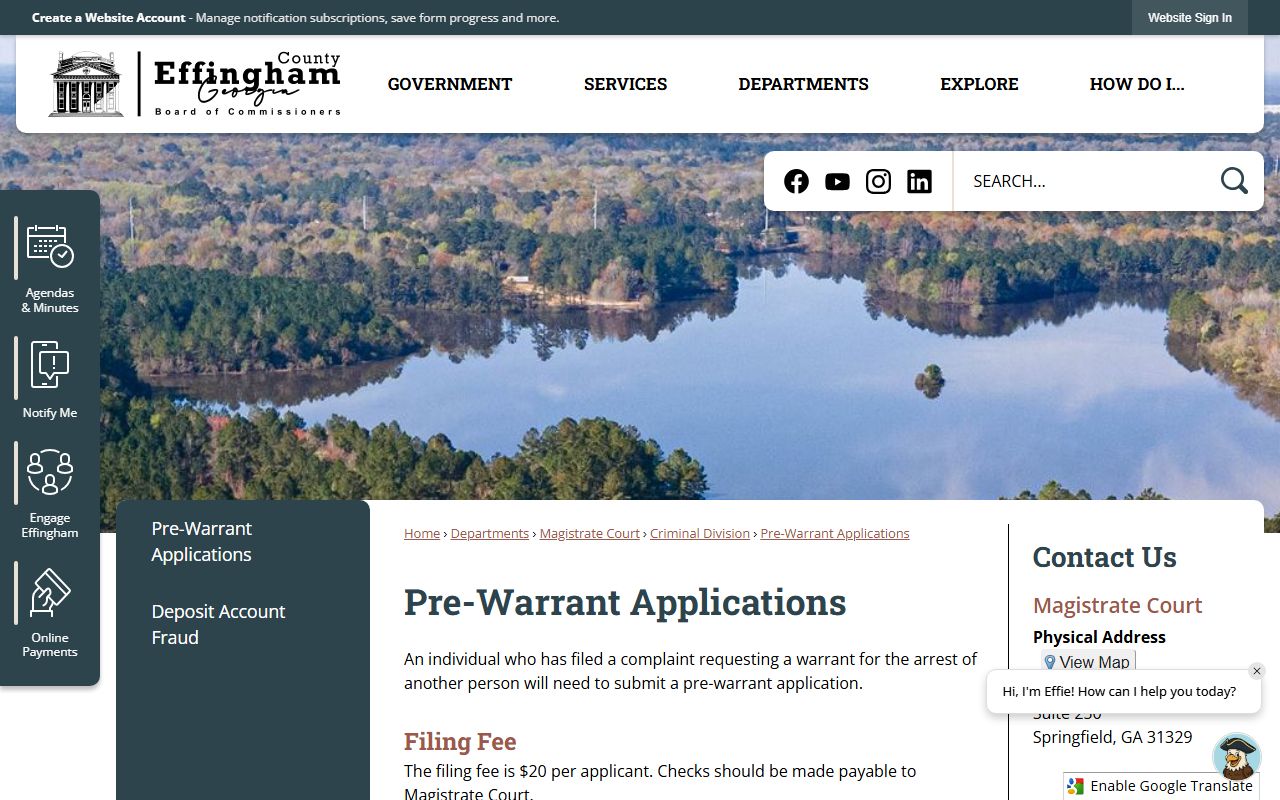
Use that source when the warrant issue starts with a private complaint rather than a police officer's direct arrest decision.
Effingham County Bad-Check Warrants
Deposit-account-fraud warrants are another local warrant path. The Magistrate deposit-account-fraud page says venue is the county where the check was delivered. The filing fee is $20 per warrant. Multiple checks from the same defendant, each less than $100 and within 90 days, may be processed on the same warrant without an added fee. Applicants may appear in person, and mailed forms must be complete, signed, and notarized.
Because this type of Effingham County warrant application can result in an arrest warrant, the court requires proper defendant identification. The applicant must provide at least one identifier such as date of birth, Social Security number, or driver's license number. That does not create a public warrant database, but it does define the fields that may appear in the local warrant application record.
| Local warrant channel | Office or source | Confirmed detail |
|---|---|---|
| Pre-warrant application | Magistrate Court | In-person application, police report, defendant mailing address, hearing notice |
| Deposit-account fraud | Magistrate Court | $20 per warrant, proper defendant identifier required |
| Bench warrant or FTA | Issuing court docket | May appear in case record, but public portal display is not guaranteed |
| Sheriff or jail check | Sheriff's Warrant Division or Jail | Use phone or in-person contact for custody and procedure questions |
| Municipal traffic warrant | Rincon or Guyton Municipal Court | City citation FTA may have separate court handling |
The county deposit-account-fraud page documents the bad-check warrant route used by Effingham County Magistrate Court.
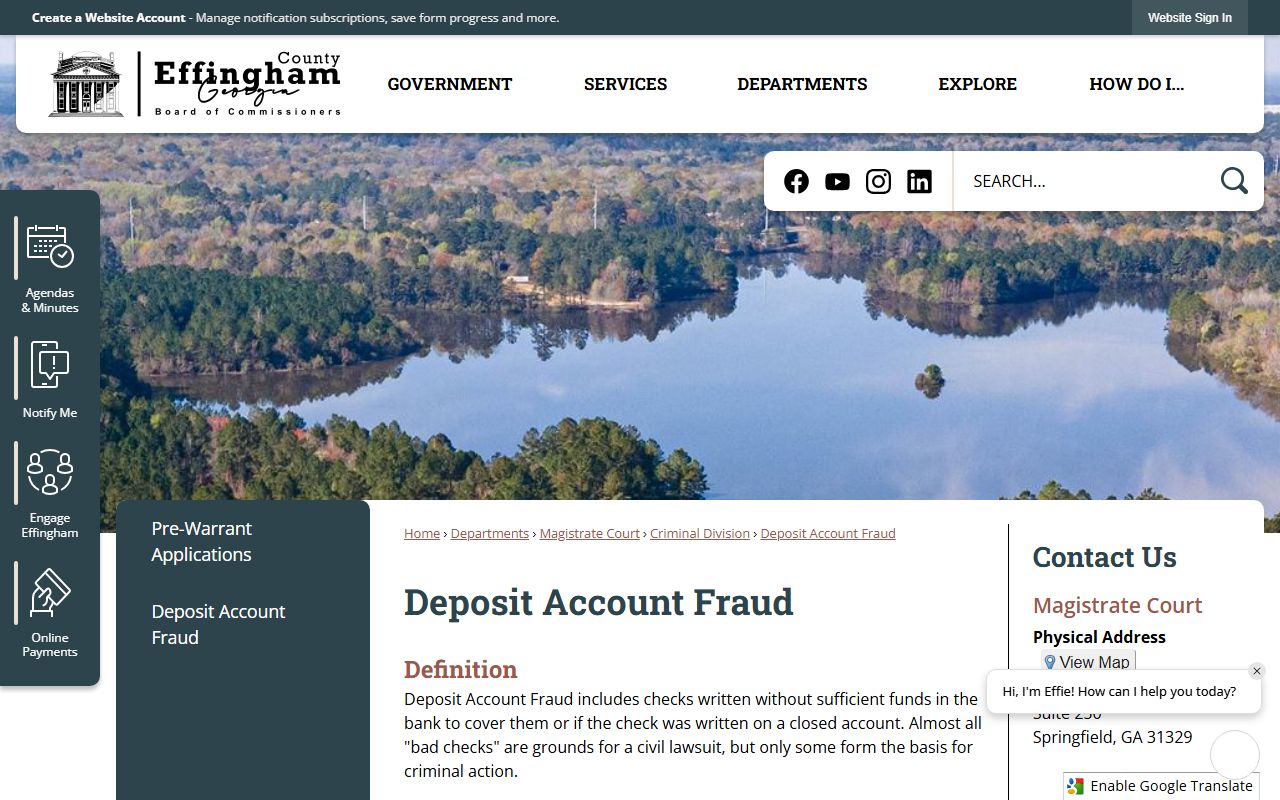
That local process is useful for understanding why a warrant record may include complainant, check, venue, fee, and defendant-identification data.
Effingham County Warrant Fields
No official Effingham County active-warrant search form was located, so the best field inventory comes from the warrant application processes and court channels described in the local research. The table below should be read as a warrant-application and access-channel table, not as a promise that a public active-warrant portal will show each field. Where a possible warrant comes from a criminal case, the court docket may use case-number, court-code, party, filing, and hearing fields instead.
| Field or item | Type | Required | Options or format notes |
|---|---|---|---|
| Respondent or defendant name | Text | Yes for applications | Full name is needed to identify the person tied to the complaint |
| Defendant mailing address | Address | Yes for pre-warrant applications | Used for hearing notice mailing |
| Police report reference | Document reference | Yes for pre-warrant applications | Applicant must bring a police report when filing |
| Date of birth, SSN, or driver's license | Identifier | At least one for bad-check warrants | Needed for proper defendant identification |
| Issuing court | Court name | Needed for follow-up | Magistrate, Superior, State, Rincon Municipal, Guyton Municipal, or another court |
| Hearing date or docket event | Date | Conditional | Pre-warrant hearings and bench-warrant events depend on court action |
Under O.C.G.A. section 15-10-2, Georgia magistrate courts have authority over arrest and search warrants, bonds, courts of inquiry, civil claims within limits, and dispossessory matters.
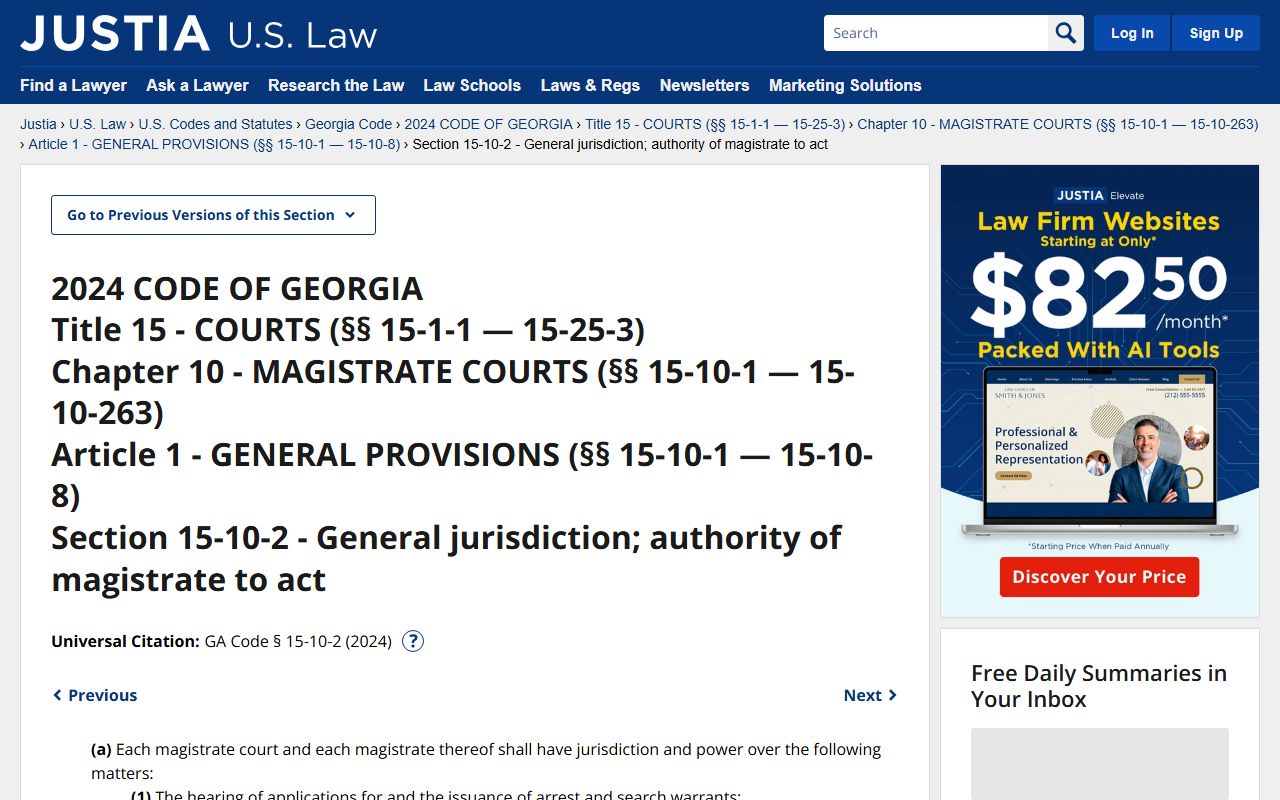
The state-law authority supports why Effingham County Magistrate Court appears in the local warrant access path.
Effingham County Warrant Record Data
The research did not capture an official active warrant sample from Effingham County. A careful record inventory should therefore stay tied to the confirmed application process. A local warrant application record may identify the applicant or complainant, the respondent or defendant, a mailing address, the police report reference, the alleged offense, the court hearing date, the probable-cause decision, whether a warrant was issued or dismissed, and the fee collected. A court docket record may show a bench warrant or failure-to-appear entry, but the portal may not show sealed, restricted, or sensitive details.
| Record field | What it shows |
|---|---|
| Applicant or complainant | The person or business seeking a warrant through Magistrate Court |
| Respondent or defendant | The person accused in the application or named by the issuing court |
| Police report reference | The supporting incident report required for a pre-warrant application |
| Alleged offense | The crime or bad-check event asserted in the application |
| Hearing or docket event | The date tied to the warrant application or court action |
| Decision or status | Whether probable cause was found, a warrant issued, or the matter was dismissed |
| Fee | Local filing cost when the warrant channel requires one |
Note: A missing online result is not proof that no Effingham County warrant exists.
Resolve Effingham County Warrants
A person who thinks an Effingham County warrant may exist should identify the issuing court before appearing. Call the court clerk or jail to confirm the procedure, then ask whether bond can be posted, whether a court date must be reset, and whether counsel should file a motion. For traffic failure-to-appear issues, contact the city or county traffic clerk and check driver-license consequences with Georgia DDS. For a criminal warrant, speak with counsel before making statements about the facts of the case.
- Identify whether the matter began in Magistrate, Superior, State, Rincon Municipal, Guyton Municipal, or another court.
- Call the court clerk or jail before appearing so the office can explain current surrender, bond, or calendar steps.
- Ask whether there is an active hold, court date, bond option, or motion needed to recall a bench warrant.
- For traffic FTA, verify court and Georgia DDS license status after the court issue is fixed.
- Keep receipts, orders, release paperwork, or dismissal records after the warrant is cleared.
Important: Do not ignore a possible warrant because court, jail, and license consequences can move on separate timelines.
The county Magistrate hearings and arraignments page is a useful source for local hearing rules and court-day expectations.
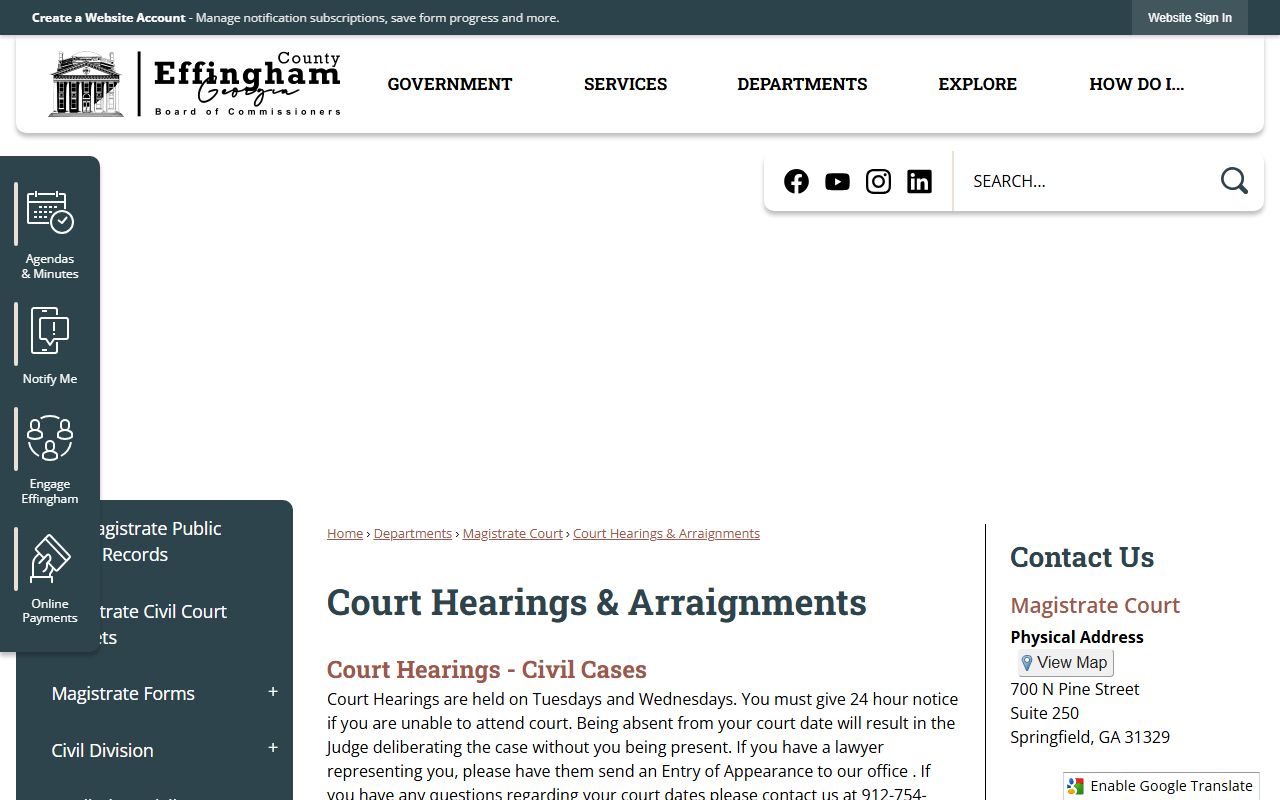
That hearing information is relevant when a warrant matter requires a court appearance or a reset hearing.
Effingham County Bench Warrants
Some Effingham County warrant questions start as missed court dates. Rincon Municipal Court warns that failure to appear can suspend Georgia driving privileges, result in an arrest warrant, and add an FTA complaint with $200 plus fees and surcharges. Guyton traffic cases use a separate municipal-court schedule and payment deadline. Superior or State Court cases may have bench-warrant entries in the court docket, but public display depends on the court system and record status.
Bond does not erase the court case. Georgia bail law, including O.C.G.A. section 17-6-1, addresses bail in criminal cases, while local sheriff and court staff handle practical bond or release steps. If a warrant record led to an arrest, related custody information may also appear through the Effingham County jail channel, and the full prosecution record belongs with the court case file.
The Georgia bail statute source documents the state-law bail context for Effingham County warrant and arrest outcomes.
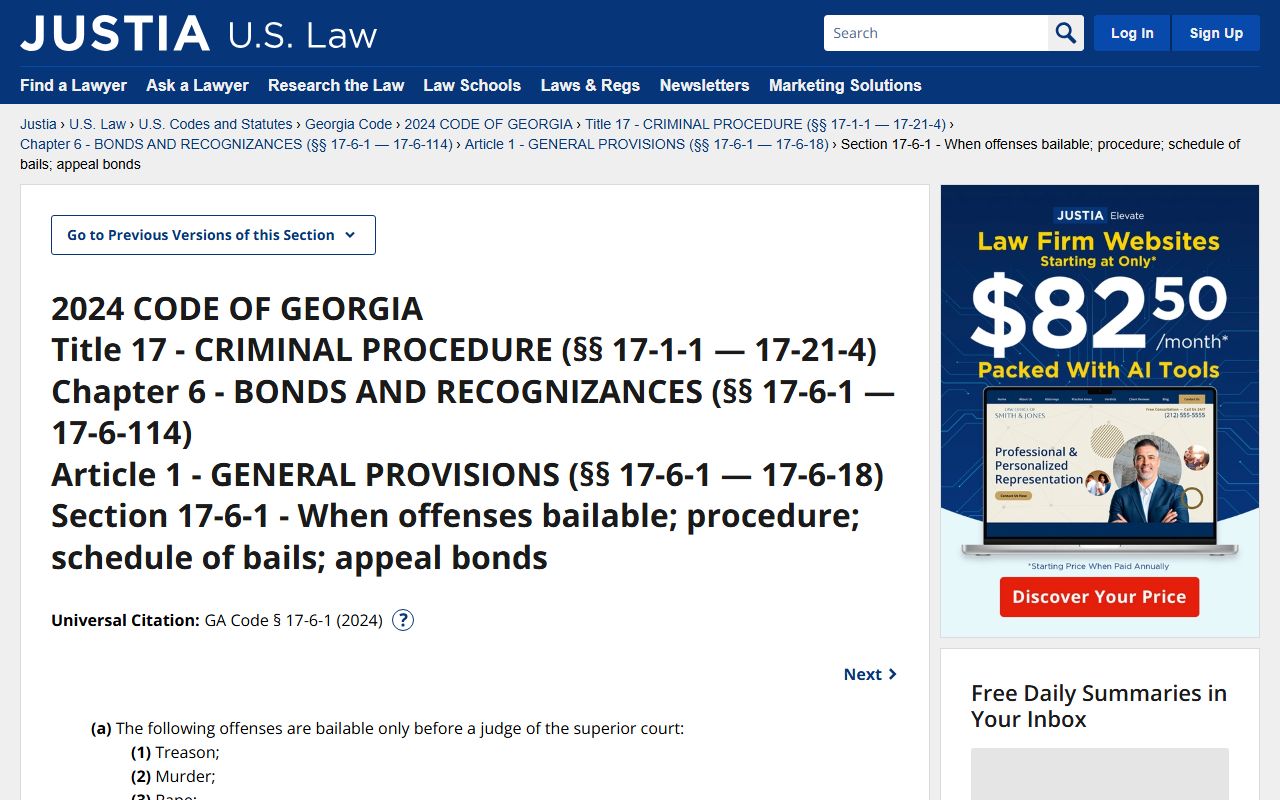
Bail information should be checked with the issuing court or jail because holds, detainers, and court orders can change release options.
Restricted Effingham County Warrants
Not every Effingham County warrant record is public. Georgia public-record access is broad, but warrants can involve sealed affidavits, confidential investigative material, juvenile matters, protected victim information, mental-health details, or safety-sensitive records. A public-records request may return only the releasable portion of a record, and some requests may be denied or delayed while an investigation or court seal is active.
There is also no official public statewide Georgia warrant search in the research file. GBI and GCIC criminal-history systems are not a public warrant-search replacement. The Sheriff's Criminal History page directs background-check and restriction visitors to the Warrant Division at the Effingham County Jail during listed weekday hours, but that service is tied to Georgia criminal history and record restriction processes, not a public active-warrant database.