
Effingham County Court Records Search
The main online gateway for Effingham County Superior Court and State Court records is the Clerk Case Management page. That page links to the official court docket search and explains that online information should be checked against the Clerk of Superior Court when accuracy matters. Georgia's statewide e-access court records page also points users back to provider sites instead of offering one central trial-court database.
Effingham County court records are not all in one index. The Clerk of Superior Court handles Superior, State, and Juvenile Court record functions. Magistrate Court keeps small claims, dispossessory, garnishment, ordinance, bad-check, and pre-warrant workflows. Probate Court keeps estate, guardianship, conservatorship, marriage-license, and vital-record matters. City traffic and ordinance citations may sit with Rincon or Guyton rather than the county case search.
- Start at the Clerk Case Management page and open the Court Docket Search link.
- Choose the court code if the portal offers one, such as Effingham County Superior Court or Effingham County State Court.
- Search by case number when known. If a name option appears, try spelling variations and last-name-first order when the portal asks for it.
- Use the result to confirm the court, case number, parties, filing date, status, and docket events.
- For certified copies, sealed cases, juvenile matters, or missing document images, contact the Clerk counter or the correct court office.
The manifest image for the Georgia Courts e-access page shows why state users are routed to county providers for local files.
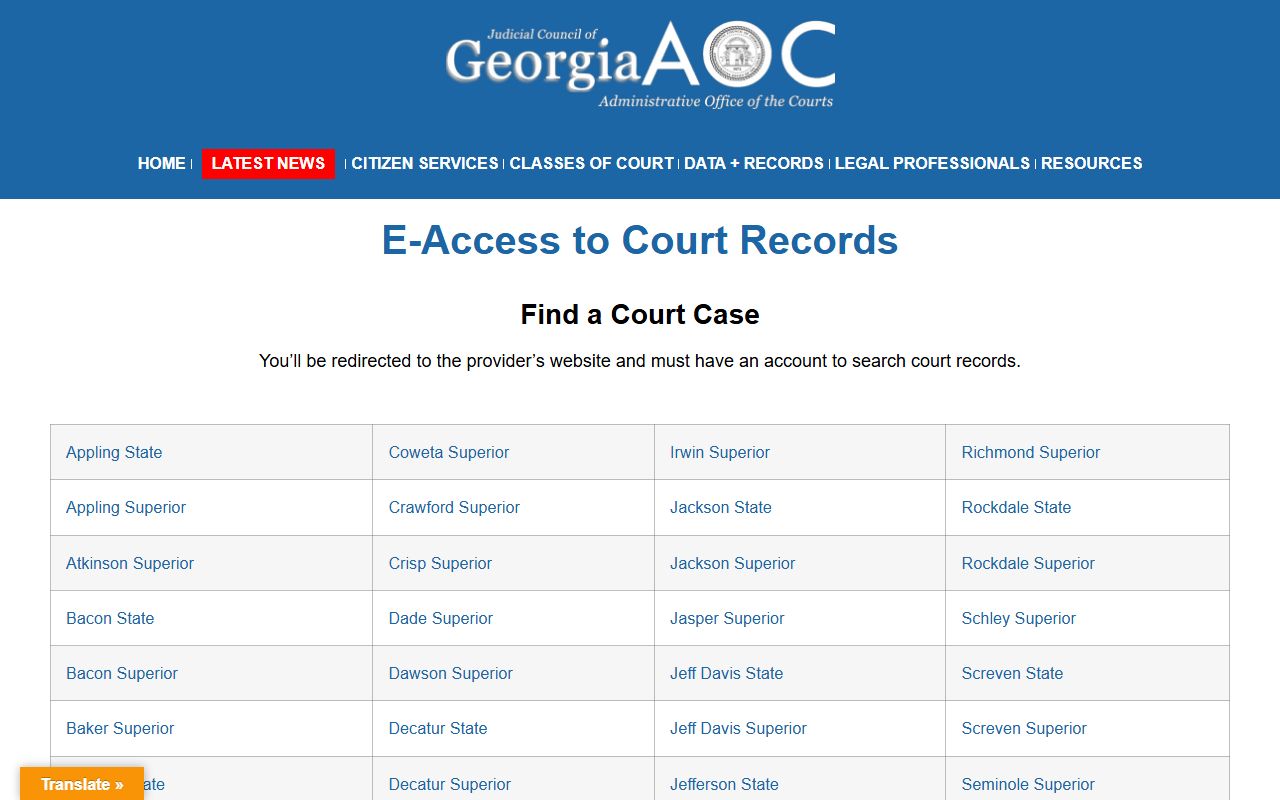
That provider model is important in Effingham County because the Clerk, Magistrate, Probate, and municipal courts do not merge every record into a single public search.
Effingham County Court Record Fields
The Effingham County case-search capture shows a case-number mode and indexed court-code choices for Superior Court and State Court. The real estate record system has clearer field labels and shows name and book/page search modes. Use the case portal for court dockets and the real estate portal only for land records, plats, deeds, liens, and related Clerk recording material.
| Field Label | Type | Required | Notes / Format |
|---|---|---|---|
| Court Code | Dropdown | When offered | Indexed choices include Superior Court and State Court for Effingham County. |
| Court Division | Dropdown | When offered | The source shows a division selector, but the options were not exposed in text capture. |
| Case Number | Text | Likely required in case-number mode | Use the exact case number from a notice, pleading, ticket, or docket entry. |
| Name | Text | Required in real estate name mode | The real estate search instructs users to enter last name followed by first name and try spelling variations. |
| Book / Page | Text | Required in book/page mode | Use this for recorded real estate instruments when a book and page are known. |
The Clerk's notary page is one of the successful manifest sources tied to record-counter services and identity rules.
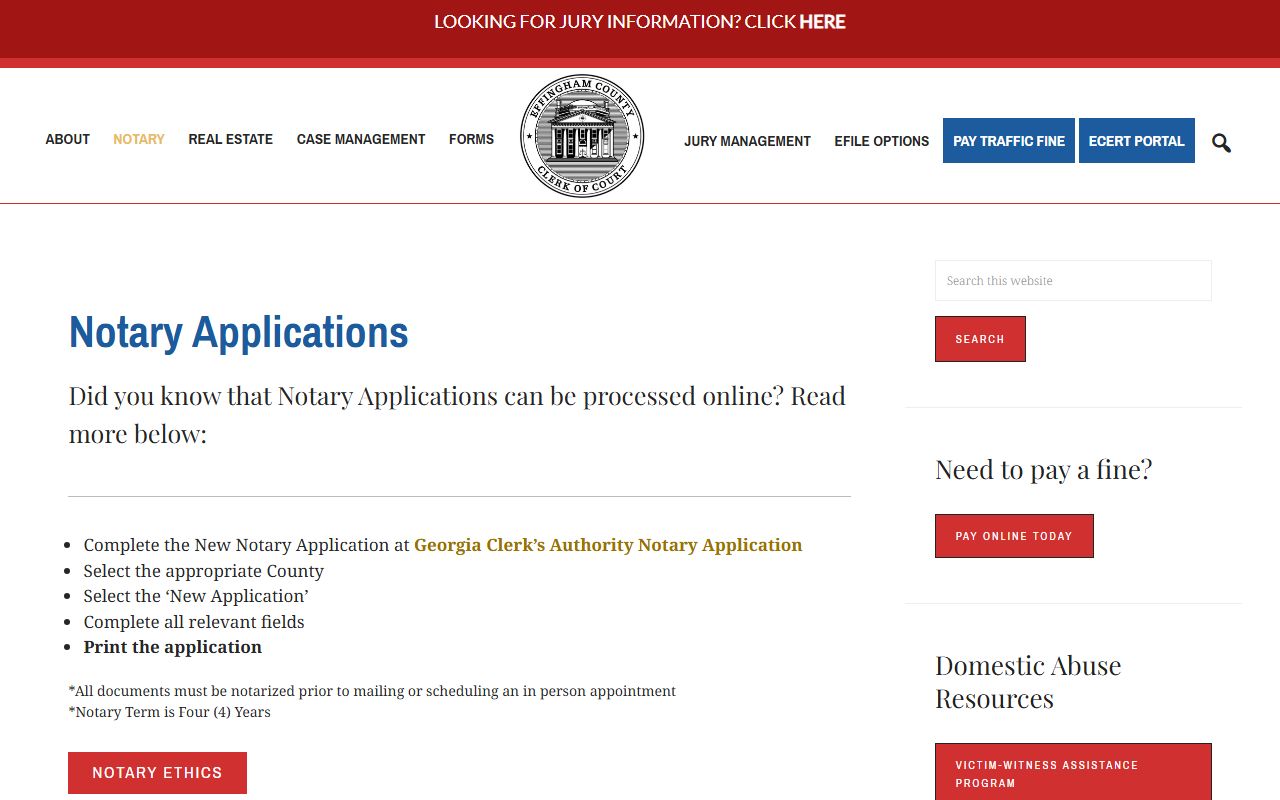
Although notary service is not a case search, the source reinforces that Clerk counter work often depends on identity, residency, payment, and appointment rules.
Types of Effingham County Court Records
Effingham County court records reflect Georgia's local court structure. Superior Court handles felony criminal cases, divorce, equity, major civil matters, title-to-land issues, and appeals from lower courts where allowed. State Court functions are managed through the Clerk of Superior Court and may involve misdemeanor, traffic, and civil matters depending on the case type. Magistrate Court covers small civil claims, dispossessory cases, garnishments, personal-property foreclosure, abandoned vehicles, county ordinance hearings, pre-warrant applications, and deposit-account-fraud warrant applications.
Probate Court records are a separate branch. They include estate petitions, wills, inventories, fiduciary returns, guardianship, conservatorship, marriage licenses, vital records, weapons permits, and passports. Juvenile Court record duties run through the Superior Court Clerk in Effingham County, but juvenile records are restricted. Municipal court traffic and ordinance records from Rincon and Guyton are handled through those city courts rather than automatically through the county Superior or State Court docket search.
- Civil court records can include complaints, answers, motions, orders, judgments, garnishments, liens, and appeals.
- Criminal court records can show charges, arraignment, motions, plea paperwork, disposition, sentencing, probation conditions, and appeal entries.
- Family court records include divorce, custody, child support, legitimation, contempt, and related Superior Court filings.
- Probate records include estates, wills, guardianships, conservatorships, marriage licenses, and vital-record functions.
- Traffic records may be found with State Court, Magistrate Court, Rincon Municipal Court, Guyton Municipal Court, or Georgia DDS.
What Effingham County Court Records Show
A court record is more than a name match. In Effingham County, the useful fields are the court, case number, division, filing date, parties, attorney names, docket events, hearing dates, judge, disposition, judgment amount, bond amount, service status, fees, and copy stamps. Magistrate archived civil docket samples show case number, plaintiff, defendant, file date, amount, and party addresses. Those samples are docket lists, not full case files, so they should not be read as proof that every document, order, or payment ledger is online.
| Field | What It Shows |
|---|---|
| Case Number | The court's identifier for a case. A Magistrate sample used a two-digit year and sequence with a civil suffix, but that is not a universal format. |
| Filing Date | The date the claim, charge, petition, or pleading entered the court record. |
| Parties | The plaintiff and defendant in civil cases, State and defendant in criminal cases, or petitioner/respondent in family and probate matters. |
| Docket Events | Chronological entries for filings, hearings, notices, orders, pleas, continuances, and dispositions. |
| Disposition | The court result or current outcome, such as judgment, dismissal, plea, verdict, or sentence. |
| Copy Status | Whether a copy is plain, certified, redacted, sealed, or unavailable through the public portal. |
Effingham County Court Records Access
Georgia public-record law supports access to public records unless a court order or statute limits release. O.C.G.A. § 50-18-70 states the open-records policy, and O.C.G.A. § 50-18-71 addresses inspection, copying, timing, and fees. Court records also follow court rules, including the public-access framework in Uniform Superior Court Rule 21 for superior-court records.
The practical rule in Effingham County is to start with the office that keeps the record. Use the Clerk of Superior Court for Superior, State, Juvenile, and real estate records. Use Magistrate Court for small claims, dispossessory, ordinance, and warrant-application matters. Use Probate Court for estates, guardianship, conservatorship, marriage, and vital-record files. Use city municipal courts for city traffic and ordinance citations. When an online portal does not show the file, the county open-records channel, the office counter, or direct phone line becomes the next step.
Note: Certified copies and sealed court records usually require office review, even when a public docket entry appears online.
The manifest image from Georgia's Open Records Act intent section supports the access framework used for Effingham County court records.
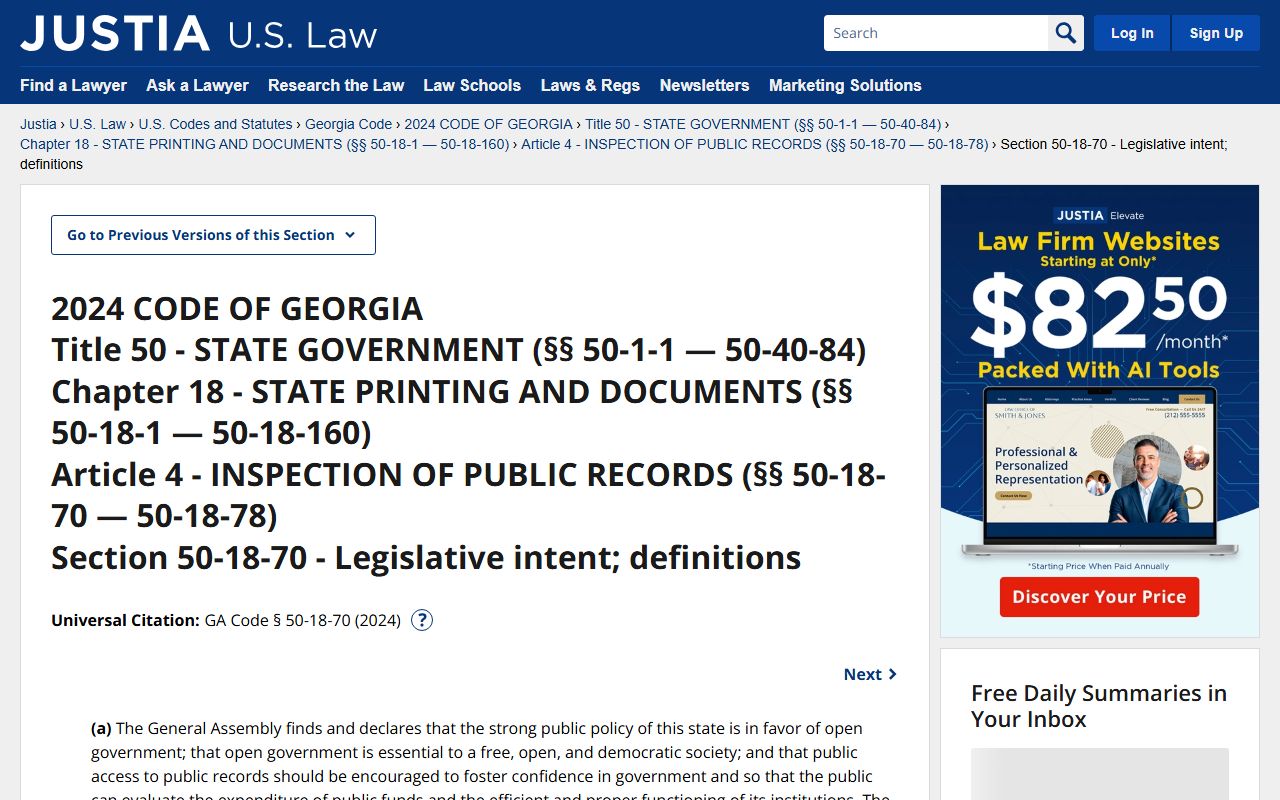
The statute source helps explain why public access starts with openness, while court-specific limits still control sealed and confidential files.
Restricted Effingham County Court Records
Some Effingham County court records are not public through a general search. Juvenile case files are handled in the court system but are not general public-record material. Adoption petitions are filed with the Clerk before fingerprinting, yet adoption records are restricted. Sealed criminal files, some mental-health information, protected victim details, minor names, full dates of birth, Social Security numbers, and financial account numbers may be withheld or redacted.
Georgia uses record restriction for many criminal-history access limits rather than a broad promise that every court file disappears. The Georgia Bureau of Investigation explains record restriction under O.C.G.A. § 35-3-37 and directs different processes based on arrest date. Effingham Sheriff's Criminal History page says local restriction matters can be handled through the Warrant Division with a local fee, but restriction of criminal-history dissemination is not the same as court sealing.
The manifest image tied to Georgia inspection and copying procedures is relevant when a public copy must be requested outside the online portal.
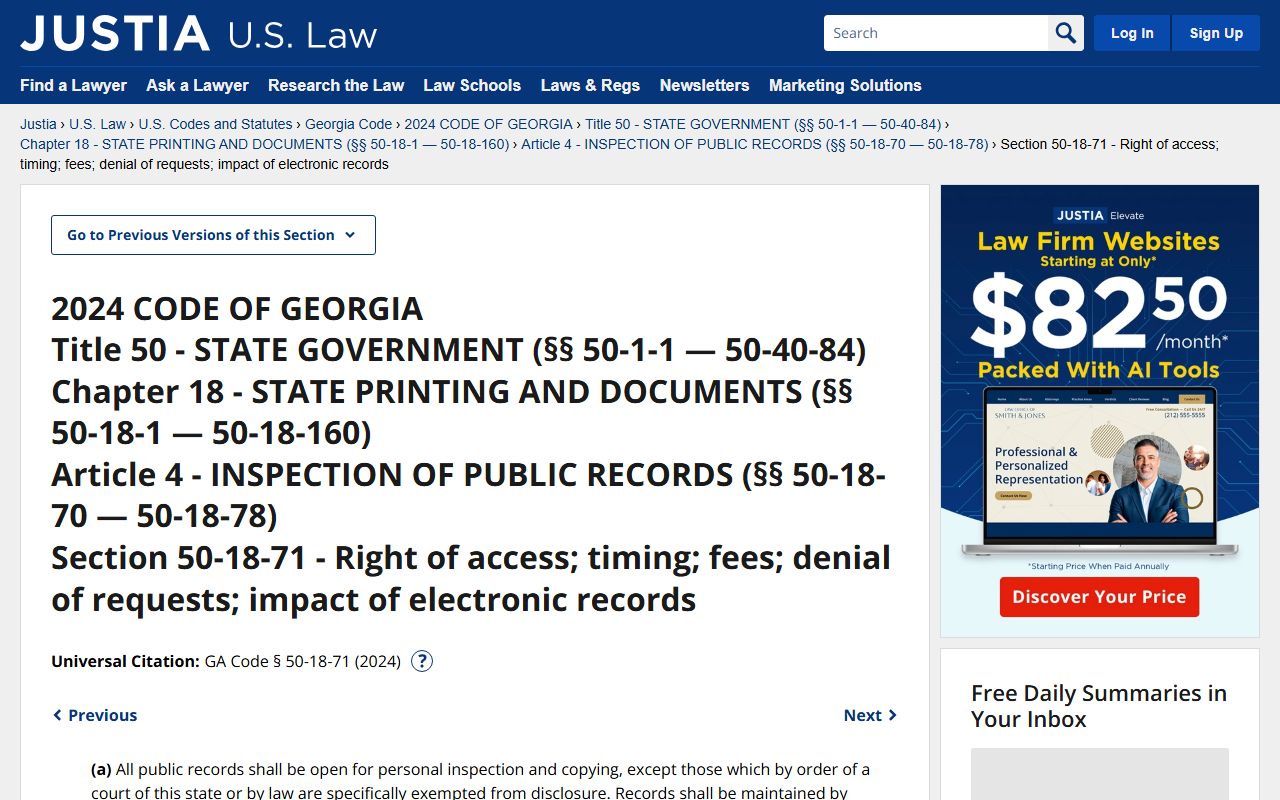
That source is especially useful when the record exists but the public version requires redaction, staff review, or a copy charge.
Effingham County Court Record Requests
For older, sealed, certified, or non-digitized court records, use the Clerk of Superior Court. The Clerk is located in the Effingham County Judicial Complex and manages court records for Superior Court, State Court, and Juvenile Court functions. The Clerk site lists Walt Lawson as Clerk of Superior Court and provides separate phone channels for general Clerk service, civil/criminal records, and traffic tickets.
Clerk of Superior Court
700 N. Pine Street, Suite 110
Springfield, GA 31329
912-754-2118
Civil / Criminal: 912-754-2146
Traffic Tickets: 912-754-2163
Hours: 8:30 a.m.-5:00 p.m. on the Clerk site
Magistrate Court record questions go to Suite 250 at the same Pine Street complex, and Probate Court questions go to Suite 146 by appointment. Rincon and Guyton municipal traffic citations should be checked with the city court that issued the citation. A reader tracking the full path from booking to prosecution may also need the Effingham County criminal court records file once charges become a court case.