
Search Effingham County Court Records
Effingham County court records for Superior Court and State Court begin with the Clerk of Superior Court Case Management page. The clerk links users to the Effingham County Superior Court Docket Search and warns that names should be searched with spelling variants. That warning matters in Effingham County because a missed middle initial, suffix, or alternate spelling can hide a docket result. The public portal is useful for case lookup, but document images, certified copies, sealed matters, juvenile cases, and older paper files may still require the Clerk of Superior Court counter or a phone call.
The same search path does not cover every court record in the county. Magistrate Court keeps small claims, dispossessory, garnishment, ordinance, bad-check, and pre-warrant application workflows. Probate Court handles estates, guardianships, conservatorships, marriage licenses, and vital records. City citations may stay with Rincon Municipal Court or Guyton Municipal Court. If an Effingham County court record does not appear in the Superior/State Court portal, use the office that created the file rather than assuming the record is unavailable.
- Start at the Clerk Case Management page and open the Court Docket Search.
- Choose the court code offered by the portal, such as Effingham County Superior Court or Effingham County State Court.
- Search by case number when known, and use spelling variations when the portal permits name searching.
- Read the docket for court, case number, parties, filing date, and current status.
- Contact the Clerk of Superior Court for certified copies, sealed-file questions, or records that do not show online.
| Portal field | How Effingham County uses it |
|---|---|
| Court Code | Indexed options include Effingham County State Court and Effingham County Superior Court. |
| Court Division | The portal shows a division selector, but the research capture did not expose all choices. |
| Case Number | Use the exact case number when available. The county did not publish one format for every case class. |
| Search prompts | Follow the prompts shown in the live portal and retry spelling variants for proper names. |
The Effingham real estate records portal is separate from the court docket search. It allows name and book/page searching for recorded land records, and the clerk states there is no charge for access to data or images. A free account is needed only for fraud notifications.
The Effingham County Clerk of Superior Court homepage shows the local gateway for court-record users, including the clerk role and public contact paths.
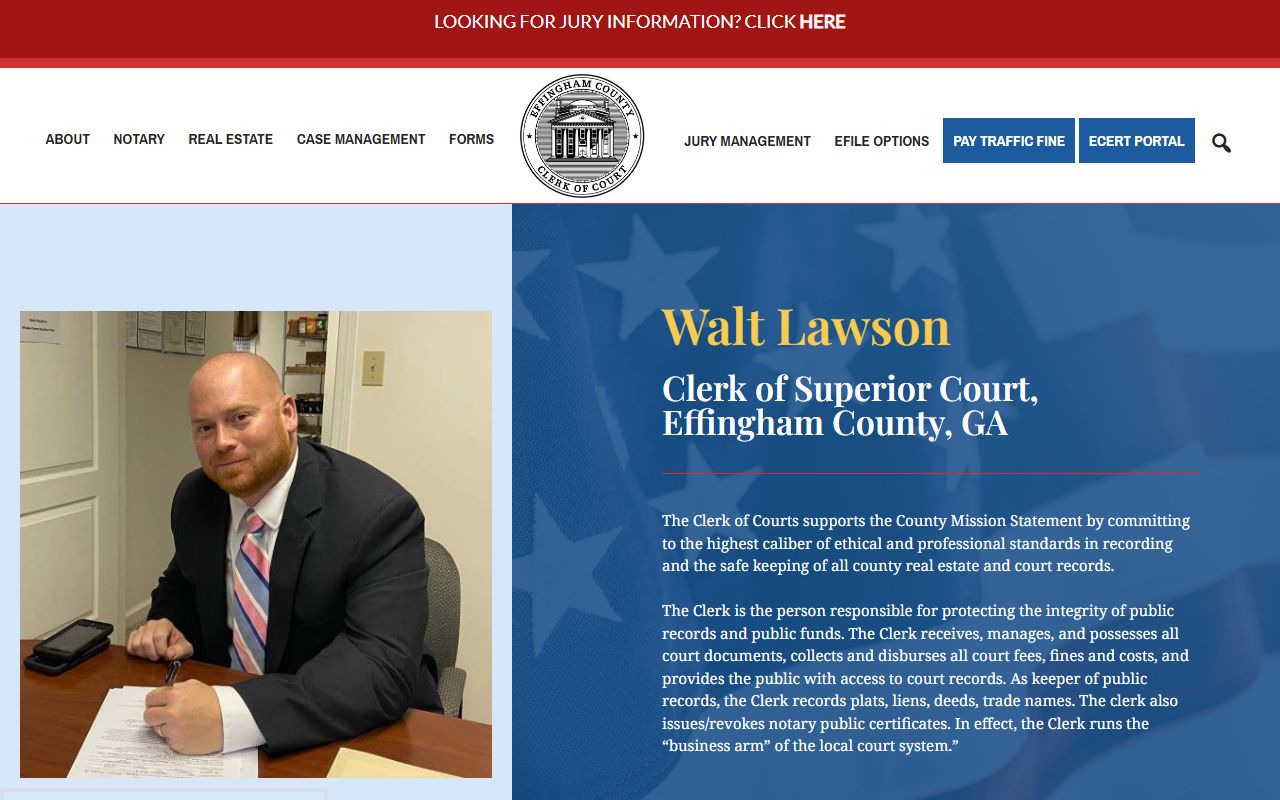
That clerk channel is the first stop for many Effingham County Superior Court and State Court record questions.
Effingham County Court System
Georgia is not a district-court state. Effingham County's general trial court is Superior Court, and the county sits in the Ogeechee Judicial Circuit with Bulloch, Jenkins, and Screven counties. Superior Court handles felonies, divorce, equity matters, major civil cases, title-to-land matters, and appeals from lower courts when Georgia law allows that path. State Court functions are also supported by the Clerk of Superior Court, while Magistrate, Probate, Juvenile, and municipal courts handle narrower record groups.
The Georgia Superior Court Clerks' Cooperative Authority profile lists Effingham County's clerk-managed functions, including Superior, State, Accountability, Civil, Drug, Jury, Traffic, and Board of Equalization. That mix explains why an Effingham County case search can touch more than one court level. A traffic citation, for example, may be a State Court matter, a municipal court case, or a driver-history issue with Georgia DDS.
Local case flow: Magistrate, Probate, State, Juvenile, or Municipal Court › Superior Court when authorized › Georgia Court of Appeals or Supreme Court of Georgia.
| Court or office | Record role | Common case types |
|---|---|---|
| Superior Court | General trial court | Felony, divorce, equity, major civil, appeals from lower courts |
| State Court | County trial court functions through the clerk | Misdemeanor, traffic, civil, and state-court matters by case type |
| Magistrate Court | Lower civil and warrant court | Small claims, dispossessory, garnishment, bad checks, warrants, ordinance hearings |
| Probate Court | Probate and vital-record court | Estates, wills, guardianship, conservatorship, marriage, licenses |
| Municipal Courts | City ordinance and traffic courts | Rincon and Guyton traffic or ordinance citations |
The GSCCCA Effingham County clerk profile provides a state-level snapshot of the clerk office, managed courts, services, and contact details.
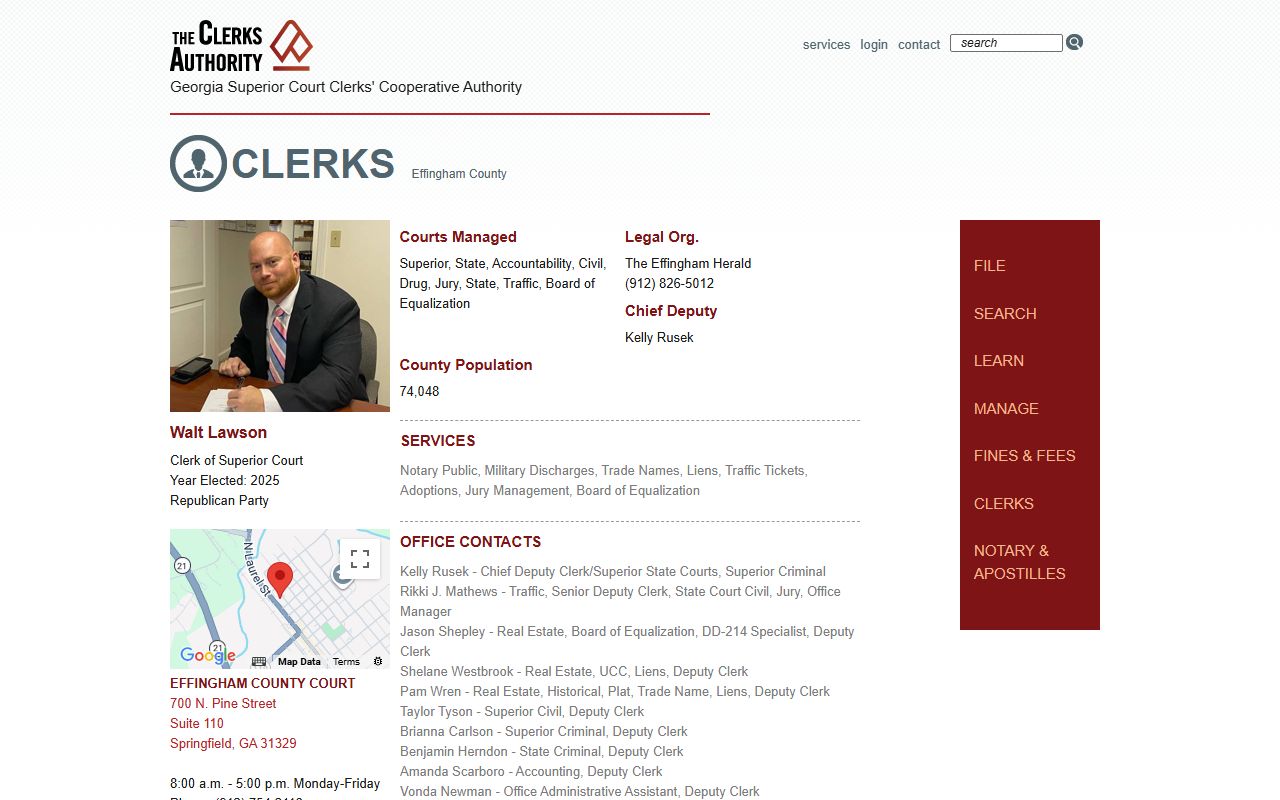
That profile helps confirm why the clerk page touches Superior, State, traffic, jury, and other record functions.
Effingham County Court Locations
Most county court records are tied to the Effingham County Judicial Complex in Springfield. The Clerk of Superior Court, Magistrate Court, and Probate Court are all located there in separate suites, which makes Pine Street the main records corridor for court users. The Sheriff's Courts Division provides security for the Judicial Complex and the Historic Courthouse, so visitors should expect courthouse screening and courtroom rules even when they are visiting a counter rather than attending a hearing.
The Historic Courthouse is a separate landmark. New Georgia Encyclopedia courthouse media identifies the Springfield courthouse as a 1908 neoclassical revival building. Court-record users should not treat that historic building as the default record counter unless a specific county office directs them there.
Clerk of Superior Court
700 N. Pine Street, Suite 110
Springfield, GA 31329
912-754-2118
effinghamclerk.org
Magistrate Court
700 N. Pine Street, Suite 250
Springfield, GA 31329
912-754-2124
Magistrate Court
Probate Court
700 N. Pine Street, Suite 146
Springfield, GA 31329
912-754-2112
Probate Court
The Effingham County Magistrate Court page documents the lower-court channel for claims, dispossessory matters, warrants, and ordinance hearings.
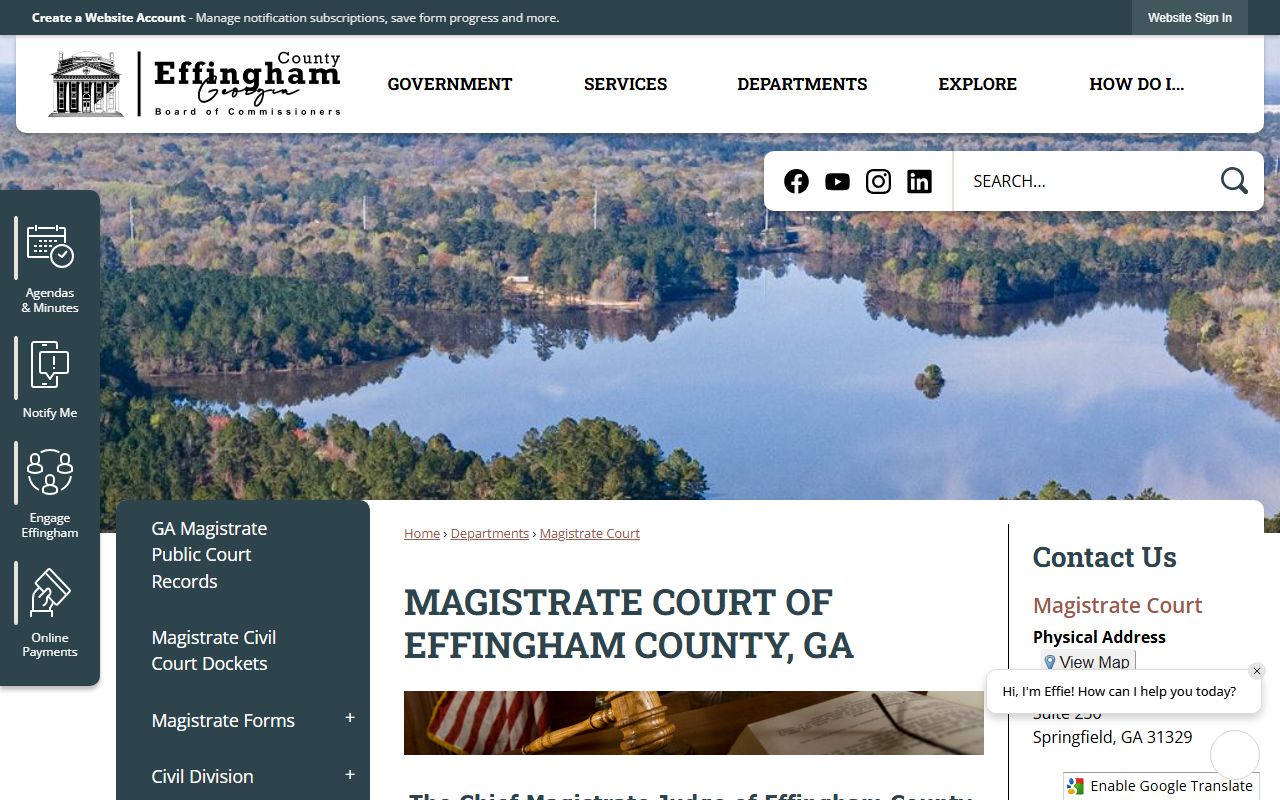
Magistrate Court is separate from the clerk's Superior and State Court docket search, so users should route those records directly to the court.
Effingham County Court Record Types
Court records in Effingham County reflect the office that creates them. Superior Court records can include felony files, divorces, equity cases, major civil cases, title-to-land disputes, and appeals. State Court can hold misdemeanor, traffic, and civil matters assigned to that court. Magistrate Court records include small claims, dispossessory cases, garnishments, personal-property foreclosures, bad-check applications, county ordinance hearings, pre-warrant applications, and bail or warrant events.
Probate Court keeps estate, will, guardianship, conservatorship, marriage-license, vital-record, weapons-permit, and passport-related filings. Juvenile and adoption records are more restricted. Municipal traffic records may be held by Rincon or Guyton, while jail booking and custody data are maintained by the Sheriff's Office and jail rather than by the Clerk of Superior Court.
- Criminal records: Felony case files, misdemeanor files, charges, pleas, motions, dispositions, and sentencing orders.
- Civil records: Complaints, answers, judgments, garnishments, liens, dispossessory matters, and claim dockets.
- Family records: Divorce, custody, child support, legitimation, contempt, and related Superior Court filings.
- Probate records: Wills, estates, fiduciary returns, guardianship, conservatorship, and marriage-license records.
- Traffic records: State Court, municipal court, citation-payment, and DDS driver-history records by source.
The Effingham County Probate Court page shows the local court channel for marriage licenses, estates, guardianships, conservatorships, and related services.
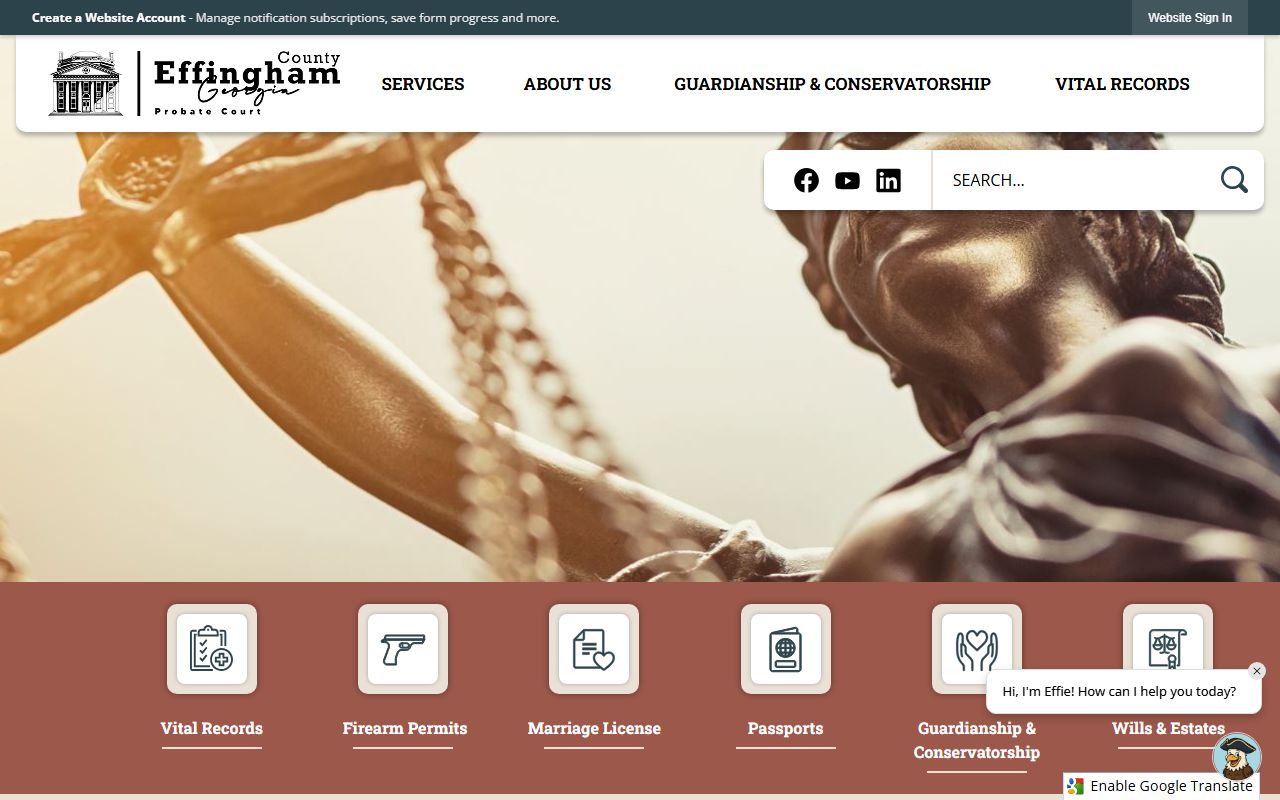
Probate records belong to a different office than criminal, civil, and traffic case files, even though the offices share the Judicial Complex.
Effingham County Court Record Fields
A court record is more than a name search result. Effingham County court records may show the court, case number, division, filing date, parties, attorney names, docket events, hearing dates, judge, disposition, judgment amount, service status, bond amount, fees, fines, and copy or certification stamps. A docket shows the timeline of a case. A full file can include pleadings, motions, orders, exhibits accepted by the court, sentencing papers, or final decrees.
The Magistrate Court archived civil docket sample found in research shows why record type matters. That sample listed case number, plaintiff, defendant, file date, amount, and party addresses for statement-of-claim cases. It did not show every order, ledger entry, service return, or hearing result. A docket is a map of the case, not always the whole file.
| Field | What it shows |
|---|---|
| Case number | The court identifier assigned to the filing or docket entry. |
| Filing date | The date a complaint, charge, petition, or claim entered the court system. |
| Parties | Names of plaintiffs, defendants, the State, applicants, respondents, or fiduciaries. |
| Charge or cause | The criminal charge, civil claim, probate matter, or traffic citation at issue. |
| Disposition | The current or final result, such as judgment, dismissal, plea, conviction, or order. |
| Sentence or judgment | The punishment, probation, fine, restitution, civil amount, or court order when public. |
Effingham County Court Access Laws
Georgia court and public-record access rules apply in Effingham County, but access still runs through the office that holds the record. The Georgia Open Records Act declares a strong presumption of public access. The inspection and copying rules in O.C.G.A. 50-18-71 cover public-record requests and fees unless a record is exempt by law or court order. Court files also follow court rules, including public-access limits for sealed and sensitive material.
Key Georgia rules:
O.C.G.A. 50-18-70 favors open public records and narrow exceptions.
O.C.G.A. 50-18-71 sets inspection, copying, timing, and fee procedures for public records.
O.C.G.A. 15-6-61 describes core Superior Court clerk duties, including keeping court papers.
O.C.G.A. 15-10-2 defines Magistrate Court powers over warrants, bonds, claims, and dispossessory cases.
Online systems do not replace official copies. Certified copies, sealed-file access, non-digitized files, older records, and eligibility-limited records should be handled with the Clerk of Superior Court, Probate Court, Magistrate Court, municipal court, Sheriff, or county open-records channel that holds the record.
Restricted Effingham County Records
Some Effingham County court records are not open through a public search portal. Juvenile files are not general public records. Adoption petitions are restricted. Probate files involving minors, guardianship, conservatorship, or vital records may require identity, eligibility, or court approval. Public copies can also omit Social Security numbers, account numbers, full dates of birth, protected minor names, victim details, and medical or mental-health information.
Georgia uses criminal-history record restriction for certain records rather than treating every matter as erased. The Georgia Bureau of Investigation restriction page explains that O.C.G.A. 35-3-37 can limit criminal-history dissemination for non-criminal-justice purposes. Effingham Sheriff's Criminal History page directs local restriction and background-check visitors to the Warrant Division at the jail, with local fees and pickup rules.
Note: Restriction of a criminal-history record is not the same as sealing every court file tied to the case.
Effingham County Specialty Courts
Effingham County is part of the Ogeechee Circuit Mental Health and Drug Court program. The clerk's treatment-court page states that the program serves Bulloch, Effingham, Jenkins, and Screven counties, and that Mental Health Court and Drug Court expanded circuitwide in July 2018. The program is designed for eligible participants whose criminal case can be addressed through treatment, accountability, and court supervision.
GSCCCA also lists Accountability and Drug among Effingham County clerk-managed courts. Detailed eligibility rules, participant counts, and graduation statistics were not located in the official Effingham sources reviewed, so users should rely on the current circuit program materials and court orders rather than assuming that every criminal case qualifies.
Effingham County Jail Records
The Sheriff's Office and jail are located separately from the Judicial Complex at 500 W. 1st Street in Springfield. The Sheriff's Office page links to jail, booking, sex offender search, crime tips, Notify Me, and online payments. The jail receives, processes, and houses people charged with felony or misdemeanor offenses, and it may also hold sentenced misdemeanor inmates or state-sentenced people waiting for transfer.
The same Effingham County Sheriff's Office source is also useful when a record search moves from a court case to booking, bond, or jail custody questions.
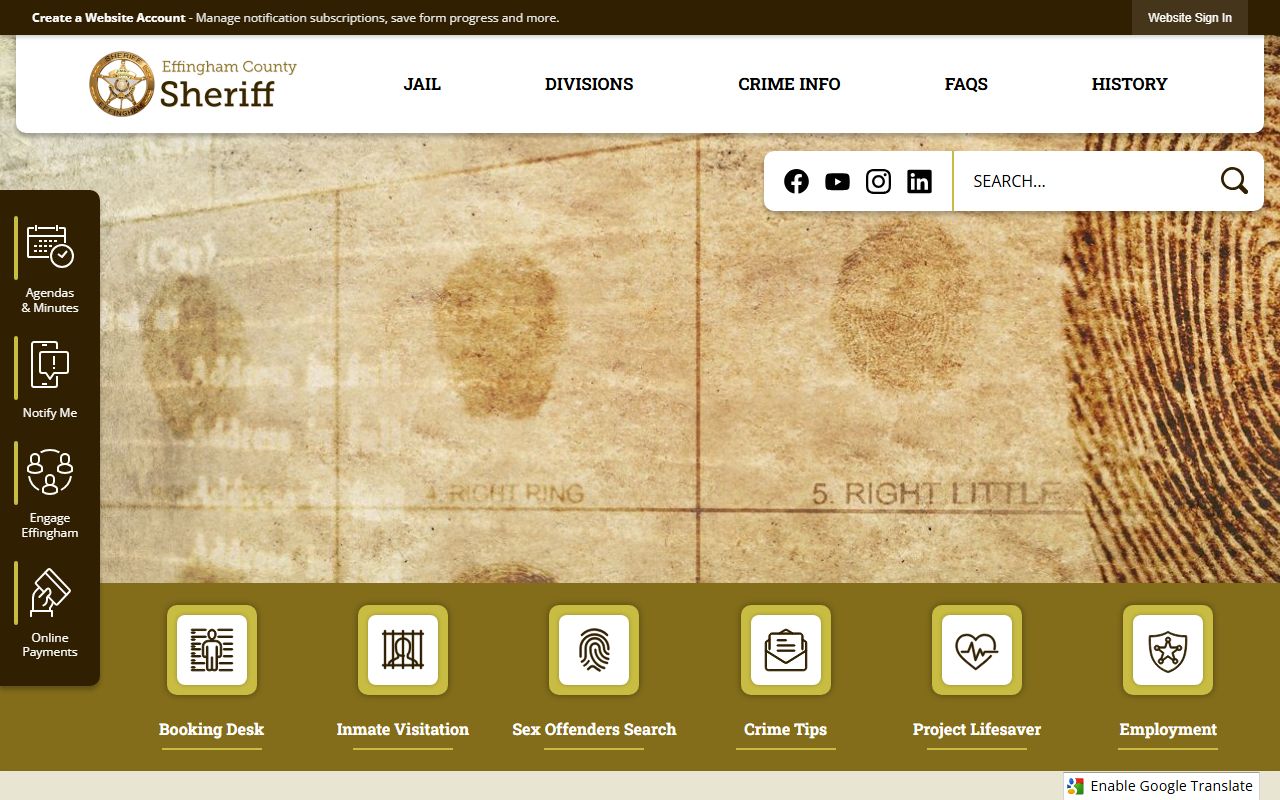
That distinction keeps jail records and court records in their proper lanes.
For jail custody lookup, the county Booking Desk page links to a vendor-hosted BlueHorse booking desk. The research session could not capture reliable public fields from that vendor page, so exact profile fields should not be assumed. For a deeper custody workflow, use the Effingham County inmate records page. Possible warrants and court-charge issues should be checked with the issuing court, jail, or Warrant Division because no official public active-warrant list was located.
| Channel | Use it for |
|---|---|
| Booking Desk | Current county jail booking access when the vendor portal is available. |
| Jail phone | Custody and visitation questions at 912-754-9715. |
| GDC offender query | State-sentenced Georgia Department of Corrections inmates. |
| GBI registry | Statewide sex offender registry searches. |
Effingham County Probate Records
Marriage licenses, wills, estates, guardianships, conservatorships, birth certificates, death certificates, weapons permits, and passport services route through Probate Court. Marriage applications may be started online through Georgia Probate Records, but the court requires an appointment. Divorce is different. Georgia divorce cases are Superior Court matters, and certified decrees should be requested from the Clerk of Superior Court.
Effingham County Probate Court lists Judge David Zittrauer and operates by appointment. The office is in Suite 146 of the Judicial Complex. Recorded marriage licenses can be searched through the statewide Georgia Probate Records marriage search, while estate and guardianship case access often requires a direct call or visit because no full public probate case portal was located.
The Georgia traffic ticket payment overview is a statewide source for citation-payment options when a traffic record is not only a county court file.
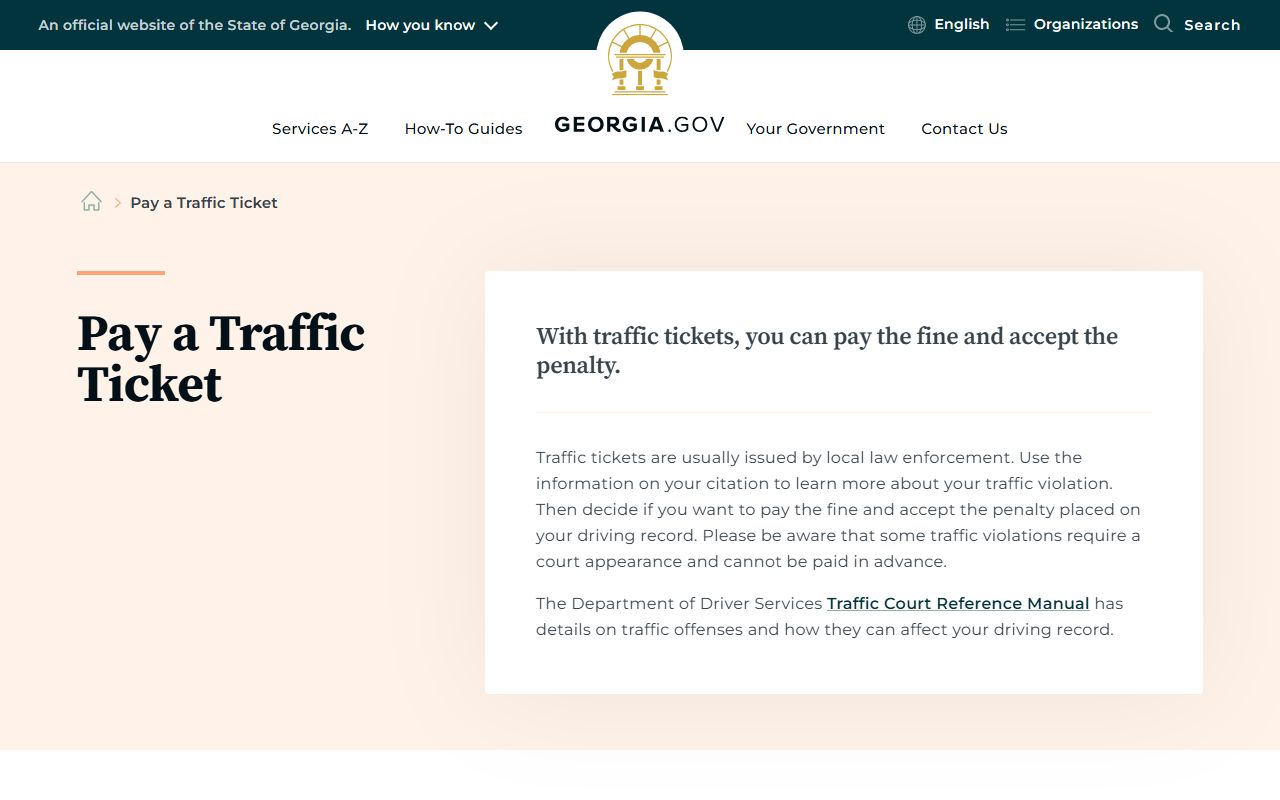
Traffic records can involve a court case, a payment vendor, and a driver-history consequence at the same time.
- Testator
- A person who leaves a will.
- Executor
- A person named to handle estate duties under a will.
- Conservator
- A person appointed to manage money or property for a minor or incapacitated adult.
- Guardian
- A person appointed to care for a minor or incapacitated adult.
Effingham County Record Fees
The clearest local fee schedule captured in the research is the Magistrate Court filing-fee schedule effective July 2024, plus Probate Court service fees. Fee schedules can change, and the Clerk of Superior Court should be contacted for court copies or certified copies not listed in the research. Probate Court and Magistrate Court both publish specific service fees that help users plan before visiting or filing.
| Item | Amount or note |
|---|---|
| Magistrate civil suit or small claim | $105 with one service, plus $50 for each additional service or re-service |
| Magistrate dispossessory summons | $80 for one tenant, plus $25 for each additional defendant |
| Magistrate criminal warrant application | $20 |
| Magistrate photocopy | $0.25 per copy |
| Magistrate certified copy | $2.50 per copy, or $10 under seal |
| Marriage license | $36 with qualifying counseling certificate, or $76 without |
| Will safekeeping | $15 per will |
The Georgia DDS points and points-reduction page explains the driver-record side of traffic cases.
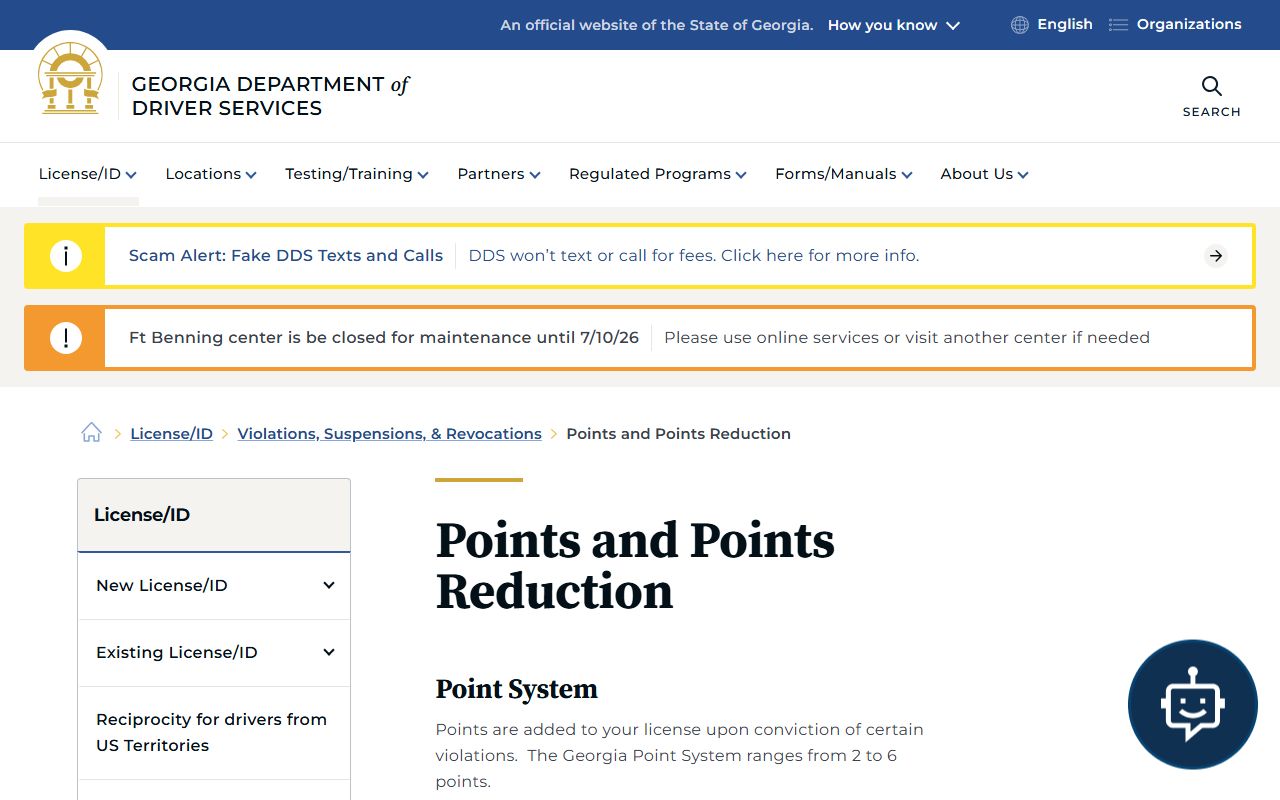
DDS points are not the same thing as the court docket, but they often follow from traffic dispositions.
Read Effingham County Court Records
A docket entry should be read in sequence. Filing dates show when papers entered the case, while hearing dates show when the court planned or held an event. A charge can be filed, amended, reduced, dismissed, or resolved by plea or trial. A civil claim can end through judgment, dismissal, settlement, or order. A probate case may move through petition, notice, appointment, inventory, annual return, and closing steps.
Terms in Effingham County records use Georgia court language. A dispossessory case is a landlord-tenant eviction action. Fi.Fa. is a fieri facias used to record or enforce a judgment lien. A disposition is the result of a charge or case. A certified copy is a copy authenticated by the clerk for official use. Those terms can affect whether a record is useful for court, licensing, employment, or personal reference.
Effingham County Record Limits
Effingham County online records may lag behind the counter file. The clerk's own case-management language states that records are provided as a public service without a warranty or guarantee of accuracy or reliability. That means the portal is a starting point, not the final authority for court deadlines, certified copies, legal status, or sealed-record eligibility.
If a record appears wrong, contact the office that created it. A Superior or State Court docket issue belongs with the Clerk of Superior Court. A Magistrate civil docket issue belongs with Magistrate Court. A jail booking issue belongs with the Sheriff's Office or jail. A driver-history issue belongs with Georgia DDS, not the municipal court that heard the citation.
Note: Confirm dates, balances, warrants, and case status with the originating office before relying on an online result.
Effingham County Court History
New Georgia Encyclopedia states that Effingham County was created in 1777 from the colonial parishes of St. Matthew and St. Philip. Springfield became the county seat in 1799. That history matters for records because courthouse locations and county-seat changes often shape where older records were created, stored, or later transferred.
The New Georgia Encyclopedia county history page provides the county-creation and Springfield county-seat background used for local court history.
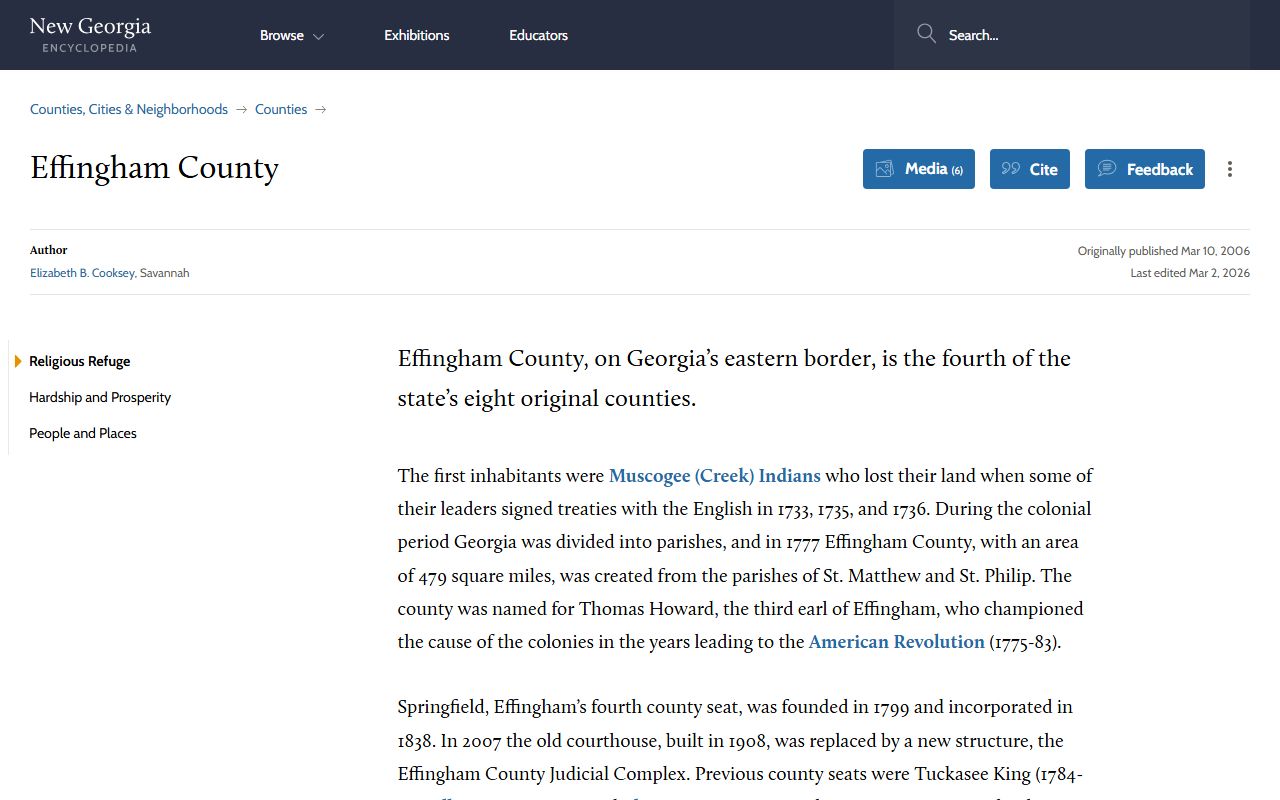
That context helps separate the historic courthouse landmark from today's court-record counters.
The modern record hub is the Judicial Complex on N. Pine Street, while the 1908 historic courthouse remains a local landmark. Recent court-system development includes circuitwide expansion of Ogeechee Mental Health and Drug Court in 2018, ongoing e-filing references on county and clerk pages, and updated Magistrate Court fees effective in July 2024.
The New Georgia Encyclopedia courthouse media page identifies the 1908 Springfield courthouse and its neoclassical revival design.
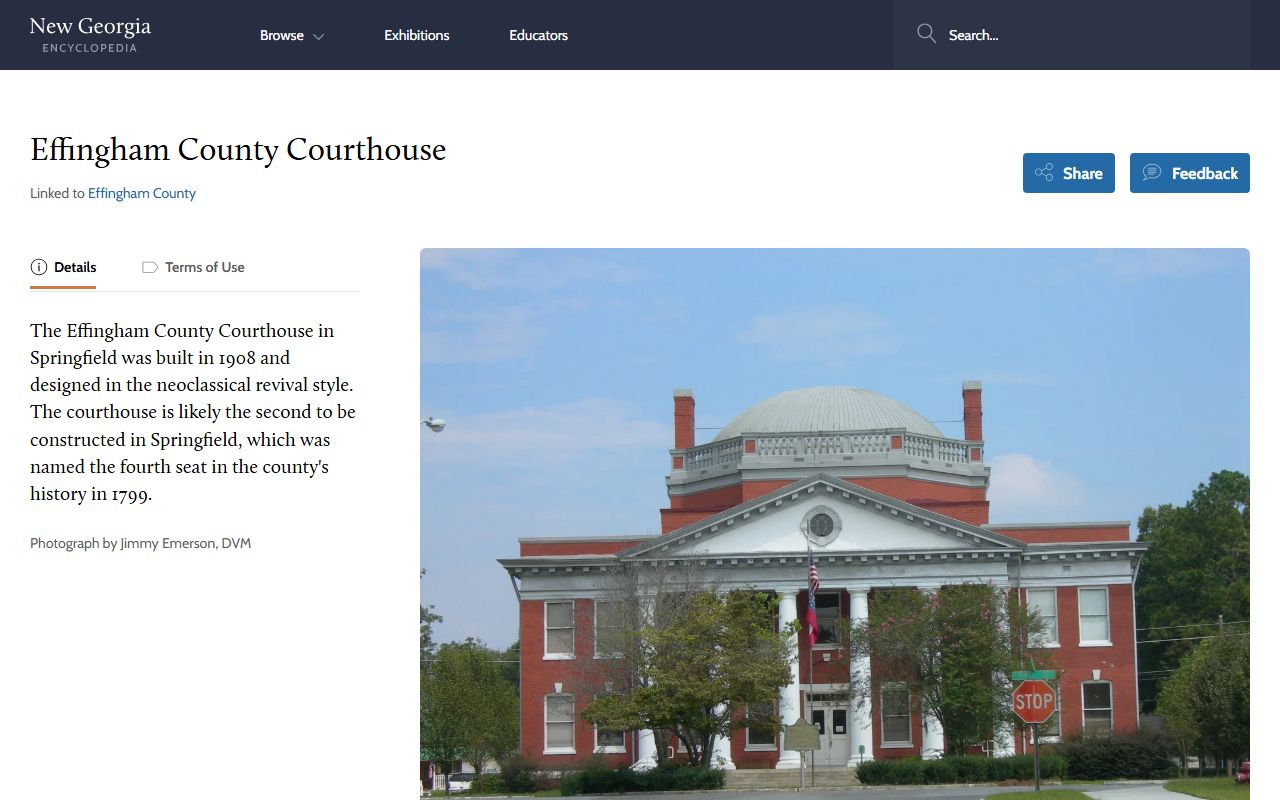
The historic building is important local court history, while current records routing still points to the Judicial Complex and relevant court offices.
The U.S. Census QuickFacts page for Effingham County gives county scale context for the local court system.
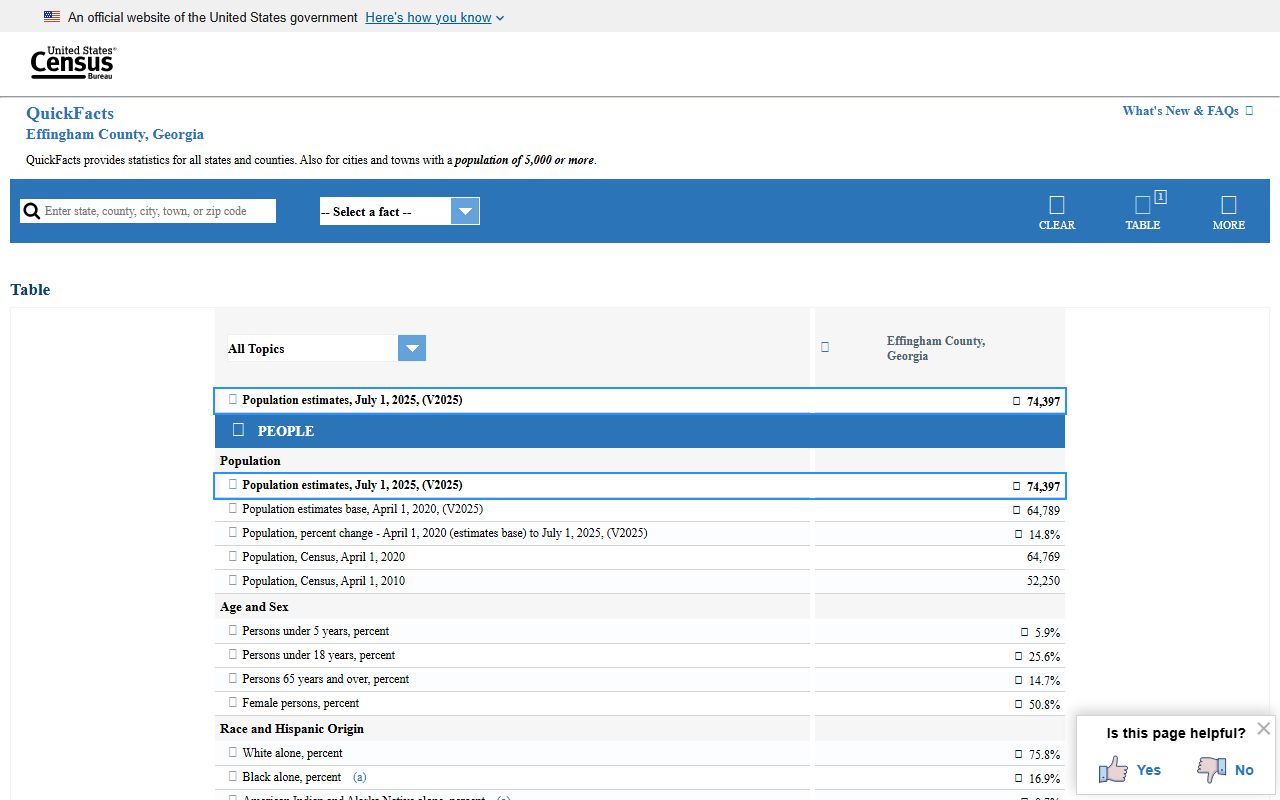
Population and land-area context help explain why record access is concentrated in Springfield while traffic and municipal records also arise in Rincon and Guyton.
Effingham County Court FAQs
Where does an Effingham County court records search start?
Superior Court and State Court case lookup starts with the Clerk of Superior Court Case Management page. If the record is Magistrate, Probate, municipal, jail, or driver-history related, use the office or agency that holds that record type.
Are Effingham County court records all online?
No. Online dockets may omit documents, sealed records, older files, certified copies, juvenile matters, and non-digitized papers. The clerk, court, sheriff, or city court may need to handle the request directly.
Who issues certified copies?
The office that holds the record issues the certified copy. For Superior or State Court files, contact the Clerk of Superior Court. For probate orders or marriage records, contact Probate Court.
Is there an active warrant search?
No official public active-warrant list was located in the research. Contact the issuing court, the jail, or the Sheriff's Warrant Division for procedure, and consider counsel before discussing criminal facts.
Where are traffic tickets handled?
Traffic records can route through State Court, Rincon Municipal Court, Guyton Municipal Court, Georgia ticket-payment channels, or DDS driver history. The issuing agency and citation location control the path.